Responsum for CKD
{{user.displayName ? user.displayName : user.userName}}
{{ user.userType }}

Already a member?
Sign inBecome part of the foremost online community!
Sign Up NowOr, download the Responsum for CKD app on your phone


CKD treatment now includes several medicines that may protect your kidneys and heart. Learn how doctors personalize care and what to ask at your next visit.
Chronic kidney disease (CKD) treatment has changed greatly in recent years. For a long time, care focused mainly on controlling blood pressure, managing diabetes, and reducing protein in the urine. These steps remain important, but doctors now have more medicines that may slow kidney damage and lower the risk of heart problems.
A recent HCPLive article, featuring kidney specialists Pranav Garimella, MD; Marc Richards, MD; and Matthew Breeggemann, MD, explains how CKD care is becoming more effective and more personalized. Here is what these changes may mean for you.*
Today, doctors may use several types of medicine together because each one works differently. Your treatment plan will depend on the cause and stage of your CKD, your urine protein level, your heart health, and whether you have conditions such as diabetes or high blood pressure.
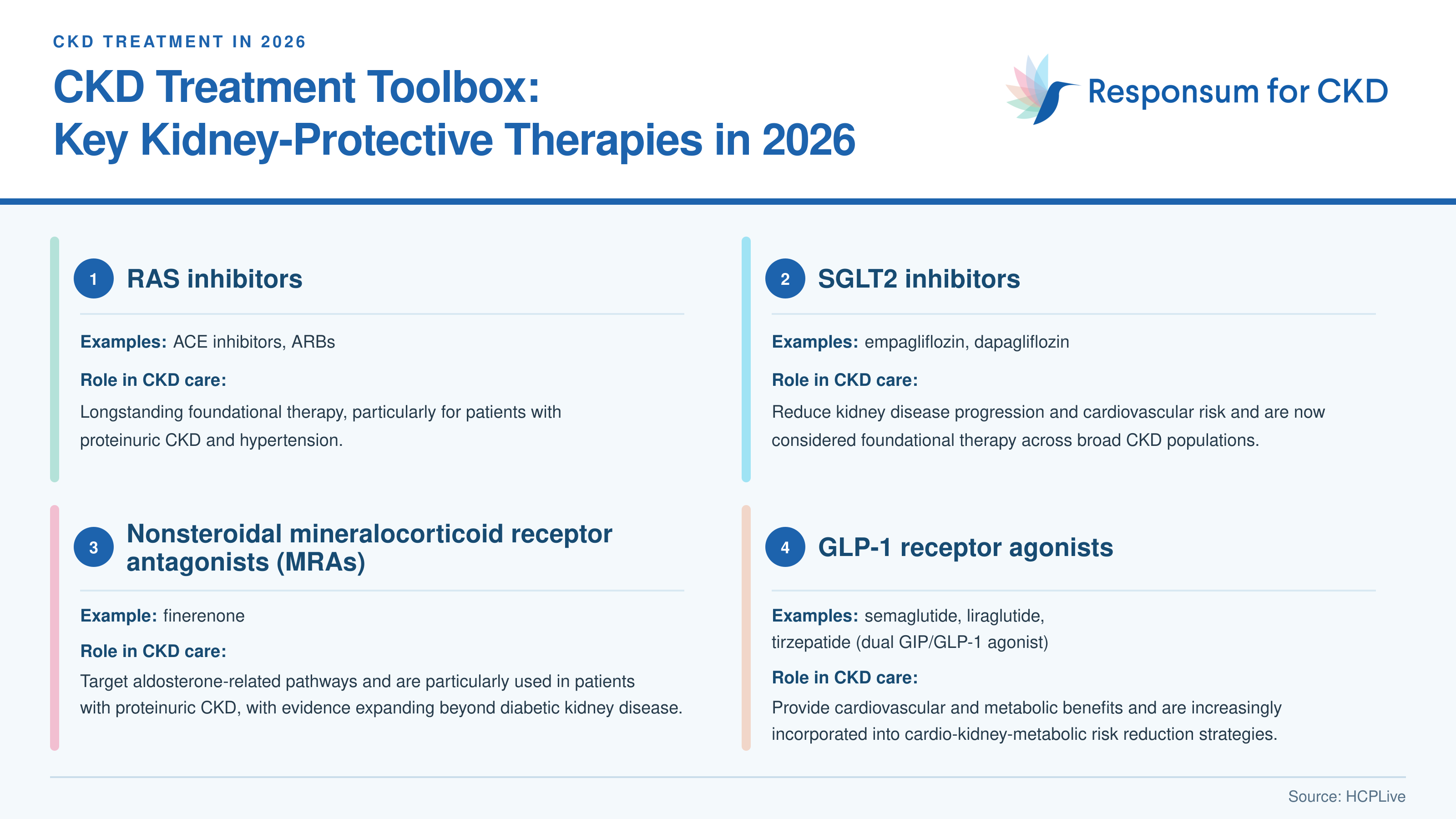
ACE inhibitors and angiotensin receptor blockers, or ARBs, have been used for many years to treat high blood pressure and protect the kidneys. These medicines are especially helpful for people who have elevated albumin in their urine. Albumin is a type of protein. When it leaks into the urine, it can be a sign of kidney damage.
Examples include lisinopril, losartan, and valsartan. Your doctor will usually monitor your blood pressure, kidney function, and potassium after starting one of these medicines or changing the dose.
ACE inhibitors and ARBs should not normally be taken together. Current kidney guidelines recommend using one or the other when appropriate. KDIGO’s 2024 CKD guideline provides more detailed recommendations based on diabetes status and urine albumin levels.
SGLT2 inhibitors were first developed to lower blood sugar in people with type 2 diabetes. Research later showed that certain SGLT2 inhibitors can also slow CKD progression and reduce the risk of heart failure in many people—including some who do not have diabetes.
Examples include dapagliflozin and empagliflozin. These medicines are now an important part of CKD care for eligible patients. However, they are not recommended for every person with CKD. Your estimated glomerular filtration rate, or eGFR, urine albumin level, diabetes status, and heart health help determine whether one may be appropriate.
Finerenone is a nonsteroidal mineralocorticoid receptor antagonist. In simpler terms, it blocks a hormone-related pathway that can contribute to inflammation and scarring in the kidneys and heart.
In the United States, finerenone is approved to lower the risk of kidney disease progression and serious cardiovascular problems in adults who have CKD associated with type 2 diabetes. Research is examining its role in other groups, but those uses are not yet established in the same way.
Because finerenone can raise potassium, your doctor must check your kidney function and potassium before and during treatment. Current FDA prescribing information limits its CKD indication to adults with type 2 diabetes.
GLP-1 receptor agonists are best known for helping manage type 2 diabetes and, in some cases, weight. They are also becoming part of a broader approach to protecting the heart and kidneys.
Semaglutide is one example. One semaglutide product is FDA-approved to reduce the risk of worsening kidney function, kidney failure, and cardiovascular death in adults with both type 2 diabetes and CKD. These medicines may be added to other kidney-protective treatments; they do not automatically replace them.
An eGFR result provides an estimate of how well your kidneys are filtering blood. It is important, but a single result does not tell the whole story.
For example, two people may both have an eGFR of 50. One person’s result may have remained stable for several years, while the other person’s eGFR may have fallen quickly over a few months. These situations may require different levels of testing and treatment.
Your doctor may also consider:
The goal is to understand not only how much kidney function you have, but also what may be causing the damage and how quickly the condition is changing.
An acute kidney injury, or AKI, is a sudden decline in kidney function. It may happen because of severe dehydration, infection, surgery, certain medications, or another illness.
Even if your kidney numbers improve afterward, an AKI should not always be treated as a problem that has completely disappeared. It can increase your risk of developing CKD or experiencing further kidney damage. Ask when your kidney function and urine protein should be checked again, particularly after a hospital stay involving AKI.
At your next appointment, you may also want to ask:
IMPORTANT: Never start, stop, or combine these medications without medical guidance. The right treatment depends on your individual health, and some medicines require careful laboratory monitoring.
CKD care is no longer limited to watching kidney function decline. For many people, today’s treatments can help slow the disease while also protecting the heart. The key is finding CKD early, following changes over time, and choosing therapies that match your specific risks and priorities.
If your treatment plan has not been reviewed recently, consider asking whether newer kidney-protective options could be appropriate for you. More choices are available—but the best plan is still the one designed around your health, your test results, and your goals.
*HCPLive. (July 30th, 2026) “Where Are We Now? Treating Chronic Kidney Disease in 2026”. hcplive.com
The information provided by Responsum for CKD is for educational purposes only and does not replace professional medical advice. Always talk with your nephrologist or other qualified healthcare provider before making changes to your treatment or kidney care. Responsum for CKD does not endorse specific treatments, providers, or products.
Source: {{articlecontent.article.sourceName}}
Receive daily updated expert-reviewed article summaries. Everything you need to know from discoveries, treatments, and living tips!
Already a Responsum member?
Available for Apple iOS and Android


We've sent a report to our community managers who will take the necessary steps. This member will be removed form your Community Chat and will no longer be able to message you.
Please contact us if you have any questions.
Add Comments
Cancel