Responsum for CKD
{{user.displayName ? user.displayName : user.userName}}
{{ user.userType }}

Already a member?
Sign inBecome part of the foremost online community!
Sign Up NowOr, download the Responsum for CKD app on your phone


National Kidney Foundation
After a career spanning 70 countries, Maxine faced kidney failure and dialysis. Read her powerful story of resilience, community, and finding hope while living with CKD.
Maxine Pestronk spent much of her life moving—across borders, cultures, and continents. Her career took her to more than 70 countries, where she worked in clinical trials to help bring safer treatments to patients around the world. But nothing in her global career prepared her for the moment her own kidneys failed—and the life-altering journey that followed. From dialysis to transplant uncertainty, Maxine’s story is one of resilience, adaptation, and choosing hope even when the path forward is unclear.
This patient story is part of NKF’s educational efforts to highlight real-life experiences of people living with chronic kidney disease and kidney failure.*
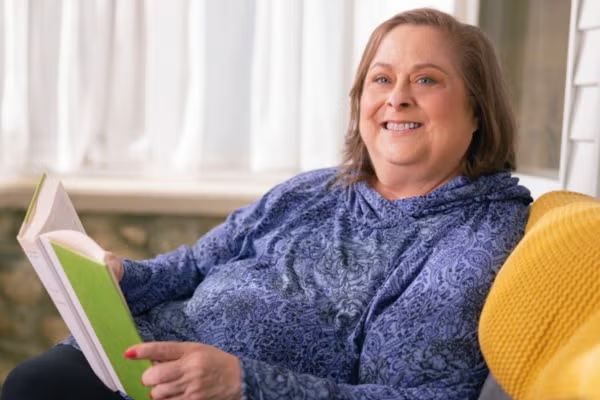
Maxine had known she had kidney disease for years. In fact, she and her mother were diagnosed around the same time in 2005.
“We never really knew why our kidneys failed,” Maxine shared. “I suspect it was the amount of salt we were raised eating.”
Over time, both of their kidney function steadily declined. Despite lifestyle changes and careful monitoring, the numbers kept dropping.
“I watched our eGFRs go down year after year,” she said. “My mother started dialysis two years before I did.”
Helping her mother adjust to dialysis gave Maxine insight—but it didn’t make facing it herself any easier.
“I had a blueprint,” she said. “But knowing what’s coming doesn’t mean you’re ready for it.”
In 2020, Maxine’s eGFR dropped to 18. The COVID-19 pandemic forced her to stay home, and instead of waiting for things to worsen, she made a proactive decision.
“I decided to get my dialysis access placed early,” she said. “Looking back, it was the best decision I could have made.”
A month later, Maxine began in-center hemodialysis.
“The relief was immediate,” she recalled. “I felt healthier, and I settled into the routine faster than I expected.”
Still, dialysis required major adjustments. Her career took a pause. Her energy shifted toward survival and adaptation.
What helped most wasn’t just medical care—it was people.
Maxine leaned into connection.
“I’m naturally talkative,” she said. “I made it a point to cheer people up, listen, and share encouragement.”
Over time, her dialysis center became a community. But it also brought loss.
“I’ve lost many friends along the way,” she said. “That part never gets easy.”
Yet supporting others—even through grief—helped her cope.
“Being there for people has helped me heal,” she shared. “Sometimes, just talking to someone who understands makes all the difference.”
Maxine began the kidney transplant evaluation process early. She was approved for the waitlist in 2018, but her case was complex.
“I have high antigens,” she explained. “That makes finding a compatible kidney much harder.”
After spending a year on a specialized transplant list and exploring advanced options—including the possibility of a clinical trial—another setback emerged.
“They found a small carcinoma in my lungs,” Maxine said.
Her transplant journey was paused.
“I completed treatment and have been cancer-free for two years,” she shared. “I need to wait three years before becoming active again—so I’m two-thirds of the way there.”
It wasn’t the path she envisioned, but she hasn’t given up.
As a dietitian, Maxine understands kidney nutrition deeply. As a human, she also understands joy.
“I love food,” she said plainly.
Life on dialysis comes with restrictions—especially around phosphorus and fluids—but Maxine focuses on balance rather than deprivation.
“I eat out, but I don’t overdo it. If I get a special meal, I enjoy it over a few days,” she said. “Food still brings me comfort.”
Her philosophy is simple: follow the guidelines, but don’t stop living.
“I have very little left in life that I can fully enjoy,” she said. “Food matters. I choose to be happy with what I eat.”
Advocacy has always been part of Maxine’s life. Years ago, she led the effort to license dietitians in Massachusetts—a six-year journey that resulted in lasting policy change.
Now, feeling stronger, she’s returning to advocacy from a new perspective.
“I recently shared my story to help raise awareness about kidney disease,” she said. “If my experience helps even one person feel less alone, it’s worth it.”
Maxine doesn’t sugarcoat the reality of kidney failure—but she refuses to let it define her life.
“Kidney failure can be fatal,” she said. “But you don’t have to live in fear.”
Her advice is simple, honest, and hard-earned:
“Stay hopeful. Build connections. And keep living the best life you can—no matter what chair you’re sitting in today.”
* National Kidney Foundation (November 6, 2025). “From World Traveler to Dialysis Chair: Lessons In Not Giving Up”. kidney.org
To ensure that we always provide you with high-quality, reliable information, Responsum Health closely vets all sources. We do not, however, endorse or recommend any specific providers, treatments, or products, and the use of a given source does not imply an endorsement of any provider, treatment, medication, procedure, or device discussed within.
Source: {{articlecontent.article.sourceName}}
Receive daily updated expert-reviewed article summaries. Everything you need to know from discoveries, treatments, and living tips!
Already a Responsum member?
Available for Apple iOS and Android


We've sent a report to our community managers who will take the necessary steps. This member will be removed form your Community Chat and will no longer be able to message you.
Please contact us if you have any questions.
Add Comments
Cancel