Responsum for CKD
{{user.displayName ? user.displayName : user.userName}}
{{ user.userType }}

Already a member?
Sign inBecome part of the foremost online community!
Sign Up NowOr, download the Responsum for CKD app on your phone


Responsum Health
Learn practical ways to delay or avoid dialysis from CKD experts and transplant recipients. Get guidance on monitoring your kidneys, advocating for better care, lifestyle habits, and staying informed about new treatment options.
Responsum Health’s recent Fireside Chat, “How to Stay Off Dialysis,” brought together CKD advocates and transplant recipients Dave White, Kevin Fowler, and Nichole Jefferson. Moderated by Responsum Health, the conversation revealed a powerful truth: while not all kidney failure can be prevented, many patients have more control than they realize.*
Here are the most important insights shared with the community.
One of the strongest themes was the importance of truly understanding your condition—not just that you “have kidney disease,” but what type and what stage.
If your doctor dismisses the question of “why” or can’t explain it clearly, that’s a sign to seek another opinion. Understanding the cause can shape your treatment, your monitoring plan, and your long-term options.
All three panelists shared moments where advocacy changed their path, especially around avoiding or delaying dialysis.
Key advocacy behaviors they highlighted:
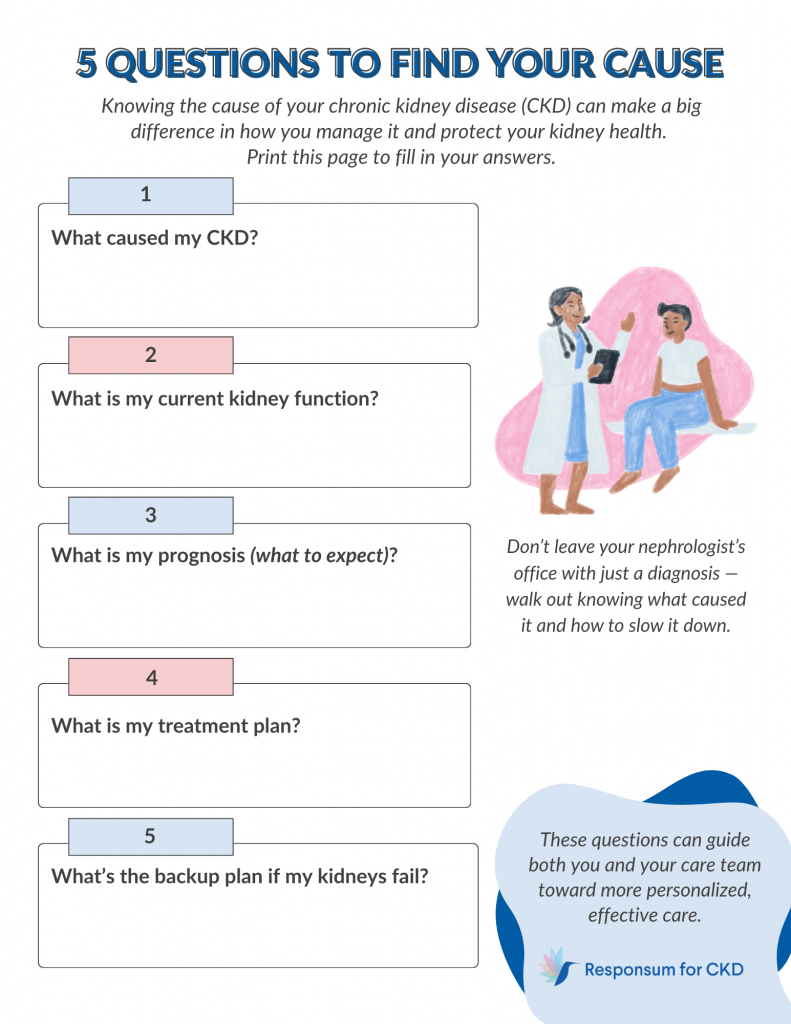
A practical tip: go to every visit with a written list of questions, and make sure you ask your top one before you leave. Those 15 minutes are yours, use them. Download the list of questions for your care team here:
Good CKD care is a partnership. The panelists recommended looking for doctors who:
If your visits feel rushed or you leave more confused than when you arrived, that’s feedback. It’s okay to say, “This isn’t a good fit for me,” and look elsewhere.
Dialysis prevention isn’t only about medications and lab numbers. The panel repeatedly returned to lifestyle and mental health as core tools for protecting kidney function and quality of life.
Living with CKD is emotionally heavy. Depression, anxiety, and burnout can lead to missed appointments, skipped meds, or unhealthy coping habits, all of which can speed kidney decline.
Panel advice included:
You see your care team only a few times a year—but you live with CKD every day. The panel encouraged patients to pay attention to basic changes and take them seriously.
Things to watch:
Use tools like patient portals (e.g., MyChart) to track your lab trends and prepare questions for each visit. Anything that seems “off” is worth raising with your doctor—don’t wait until it becomes a crisis.
For many people, kidney transplant can be a better option than long-term dialysis, but planning takes time.
Panel guidance:
Several panelists described preemptive transplants (before starting dialysis) that were only possible because they pushed for answers, got biopsies, and started the listing process years in advance.
At the same time, they were honest: transplant is not a cure. It’s another stage of CKD, with its own medications, risks, and work. But for many, it’s still far better than long-term dialysis.
Innovation in kidney care is moving faster than ever; new drugs, new approaches, and new devices are in development.
Practical ways to stay informed:
The key message: hope is real—but it’s not a reason to wait passively. New options work best when you’re already engaged in your own care.
Across the entire conversation, one message kept resurfacing: do not accept the status quo.
You deserve to understand your diagnosis, to be heard in the exam room, to access mental health support, to explore transplant and clinical trials, and to be part of decisions about your own body.
You may not be able to control everything about CKD—but you can control how informed, prepared, and supported you are. And that can make a real difference in how long you stay off dialysis and how you feel along the way.
* Responsum Health—Fireside Chat Session (November 20, 2025). “How to Stay Off Dialysis: Tips for Taking Charge of Your CKD Journey”
To ensure that we always provide you with high-quality, reliable information, Responsum Health closely vets all sources. We do not, however, endorse or recommend any specific providers, treatments, or products, and the use of a given source does not imply an endorsement of any provider, treatment, medication, procedure, or device discussed within.
Source: {{articlecontent.article.sourceName}}
Receive daily updated expert-reviewed article summaries. Everything you need to know from discoveries, treatments, and living tips!
Already a Responsum member?
Available for Apple iOS and Android


We've sent a report to our community managers who will take the necessary steps. This member will be removed form your Community Chat and will no longer be able to message you.
Please contact us if you have any questions.
Add Comments
Cancel